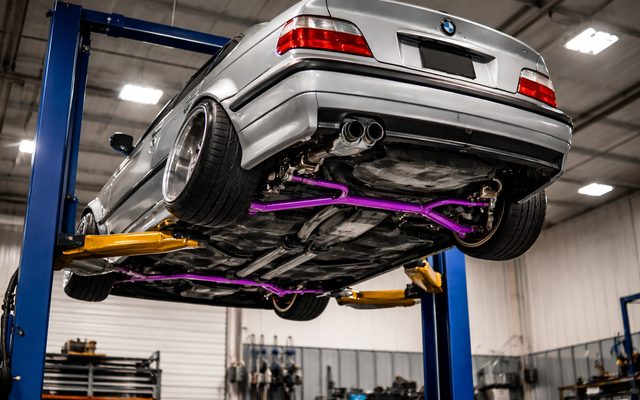
Within the demanding realm of today's professional oversteer competition, success is not merely purely a function of sheer horsepower or pilot aggression. Conversely, it has become a intricate engineering challenge that requires a scrupulous fusion of choosing a time-tested car, equipping it with the most precise competition components, and, most importantly, grasping its live behavior on the track through sophisticated drift telemetry software. This comprehensive handbook functions as your master plan starting from the initial concept of a project car through to the last data-informed adjustments that transform a capable car into a predictable champion. We will examine in detail the art and science of car suspension tuning, illustrating how a state-of-the-art vehicle dynamics tool like precise measurement hardware eradicates approximation and offers exceptional clarity into your chassis's real-world dynamics.
The bedrock of any successful competitive sliding vehicle is, indisputably, the base vehicle itself. Several cars have earned iconic reputation within the global drifting community due to their built-in handling characteristics, durable build quality, and the immense range of aftermarket support available. Selecting the optimal starting point is the initial and most significant decision a driver will make. To illustrate, the the E36 generation BMW is universally acknowledged as among the best balanced cars for drifting of history. Its near-perfect 50/50 weight distribution, alongside a driven rear axle configuration and bulletproof six-cylinder powerplants, creates a car that is simultaneously forgiving for beginners and extremely capable in the possession of a expert driver. The next step of this concept, the BMW E46, refines these attributes with a more developed chassis, increased wheel track for enhanced confidence, and even a greater degree of steering angle as standard from the manufacturer. A distinct powerful contender in the pro arena is the C6 generation Corvette.
This American track weapon brings a particular set of strengths to the drifting discipline, including a light aluminum frame, a backwards-positioned gearbox and differential unit that helps create an ideal front-to-rear mass ratio, and the immense thrust of a large-displacement LS V8 motor. This fusion makes it an complete weapon on track, able of entering and maintaining extended angles with seemingly easy deployment of throttle. For builders desiring exceptional bang-for-the-buck, the Nissan Z33 stands out as a top-tier choice. It is delivered from the factory with a rigid body structure, a decent factory LSD, and the responsive V6 engine that offers sufficient performance for practicing and progressing in the sport. Its successor, the 370Z model, presents more advancements in chassis stiffness, steering geometry, and overall motor performance, establishing its status as a favorite choice among serious competitors. Additional iconic cars that merit consideration are the agile unique Mazda FC, the most popular Nissan S13, the torque-rich Ford Mustang SN95, the modern BMW E90, and the small yet incredibly fun and teachable Mazda MX-5. All of these chassis gives a unique palette of traits, difficulties, and capabilities, but they all have in common the core ingredients necessary to become a serious sliding vehicle.
However, picking the correct car is only the beginning. To unlock the complete performance of every of these cars, significant modifications to the steering geometry and chassis control systems are completely mandatory. This is where the domain of performance drift-spec parts comes into vital importance. The one most transformative upgrade for a purpose-built drift machine is the fitting of a high-performance angle modification kit. These advanced kits, for example those engineered by specialist companies like SLR, are created to dramatically increase the car's maximum lock-to-lock rotation. A factory street car is severely restricted in how far its front wheels can turn, a design limitation for on-road driving. In sliding, however, aggressive steering input is continuously required to catch and sustain a angle. An steering kit replaces the factory hubs, rod ends, and potentially suspension arms with components that allow the front tires to reach degrees of turn beyond 70 or even 80 degrees, compared to a normal OEM setting of around 40 to 50 degrees.
This tremendously increased lock provides the pilot with significantly enhanced command during a drift, making it much more straightforward to begin a oversteer moment, maintain it through a long turn, and transition smoothly from one angle to another. The contrast in drivability is absolutely revolutionary. Paired with a appropriately chosen steering kit is the just as essential upgrade to the chassis's suspension. Store-bought or even high-end street coilovers are just not designed for the specific and extreme demands of sliding. A purpose-built set of adjustable dampers is of utmost importance. These specialized dampers have custom piston tuning and spring strength that are tuned for the extreme mass transition that is typical of drifting. When a operator starts a angle, the vehicle's inertia is thrown forcefully to the outer of the turn. Proper competition coilovers control this shift in a predictable way, allowing the vehicle to stabilize promptly and giving the pilot accurate response through the controls and cockpit. They additionally enable exact tuning of ground clearance, rebound and compression stiffness, and corner weighting, which are all integral aspects of dialing in the car's handling to a given track or driving technique. Together, a high-quality drift angle kit and a correctly chosen pair of drift-spec adjustable dampers are the undeniable physical cornerstone upon which all subsequent refinement is based.
Once the fundamental hardware is in place, the subsequent critical step in the project is the meticulous setting of the vehicle's suspension geometry. This is the domain of car suspension tuning, a methodology that can feel daunting to the beginner but is, in reality, the key to converting a set of fast parts into a unified and consistent whole. The most critical element of alignment for oversteer is certainly negative camber. Camber angle is the angle of the rim in relation to the perfectly straight plane when viewed from the front-on of the vehicle. If the top of the tire is tilted towards the chassis, this is called inward tilt. For oversteer driving, an inward tilt on the front wheels is widely used and is seen as necessary. The purpose is intrinsically linked to physics.
When a chassis is cornering at high angles, the chassis tilts toward the outer of the turn. This chassis roll forces the outside steering tire to diminish its optimal grip area with the tarmac. By adding inward lean, the tire is pre-angled to account for this roll. As the vehicle tilts into the corner, the tire gains a better contact patch against the track, optimizing its bite at the precise time when it is absolutely essential for control. Usually, front axle adjustments for a dedicated drift machine vary from approximately -3 degrees to as high as -5 degrees or even more, depending on the details of the vehicle geometry, tire choice, and pilot style. The back tires also employ negative camber, but the settings are typically more modest and less aggressive than the front axle. Overly aggressive negative camber at the rear can cause the vehicle to excessively tail-happy and challenging to predict on acceleration input, as it shrinks the effective contact patch of the driving wheels during straight-line acceleration. Therefore, rear camber settings are often in the range of -1 degree to -3 degrees, finding a careful compromise between offering enough cornering grip to help in initiating and holding the drift while still keeping usable hook-up for exiting the turn. camber angle is only one part of the larger alignment picture, which furthermore involves toe setting, caster angle, and steer correction adjustment.
Toe refers to the orientation of the tires as seen from above. Toe-in means the leading edges of the tires are closer together than the rear edges, while negative toe means the converse. For sliding, a small amount of front axle negative toe is frequently used to improve the initial response handling response, making the chassis feel more responsive and willing to initiate a oversteer moment. Rear axle toe is typically set to neutral or a extremely slight amount of positive toe to encourage stability under throttle. caster angle is the forward or aft angle of the steering axis when observed from the side-on of the vehicle. More positive caster enhances feedback and high-speed solidity, and it additionally adds to inward lean gain during turning, which is highly useful. Adjusting these values is a intricate dance where a adjustment to a single parameter can and often will impact the remaining parameters. The old-school process for tuning a chassis's alignment for competition has long been a labor-intensive process of experimentation and feeling. A pilot or engineering group would make a modification based on experience, test the chassis on track, rely on the operator's subjective sensation and impressions, and then make an additional adjustment. This loop would iterate over and over until the vehicle felt "acceptable" or the available testing period ran out. This approach is not just incredibly slow in terms of man-hours and resources, but it is additionally inherently flawed.
Human perception is a famously subjective data source, colored by many elements such as fatigue, varying track surfaces, weather, and simply the mood of the pilot on that given run. What feels "loose" on one lap might feel "understeery" on the following pass, causing confusing feedback and ineffective changes. This long-standing limitation in chassis setup is precisely where modern engineering tools has intervened to completely change the methodology.
The development and application of specialized drift telemetry software has ushered in a new age for engineering and refining high-performance drift machines. This new generation of platforms, showcased by cutting-edge products like GripDial, function by actively recording the actual dynamic movement of the car as it is operated on the circuit. Unlike relying on subjective feedback, these devices acquire quantifiable information on key parameters such as suspension travel, wheel speed, lateral and longitudinal g-forces, lock position, and driver input position. This collected data stream is then interpreted by sophisticated algorithms that can visualize and interpret the metrics in a comprehensible manner. For the first time, drivers and crews can see specifically what the chassis is performing at every point of a slide. This capability revolutionizes the whole suspension tuning workflow. Think about the specific goal of optimizing the front negative camber for a specific car. Rather than making a modification from -3 degrees to -3.5 degrees and then testing multiple runs to try and "feel" a improvement, a vehicle dynamics tool can provide instant and irrefutable information. The software can indicate graphically how the suspension's grip is acting during the most important moments of a slide: the initial flick, sustain, and changing direction. It can show if the present angle is permitting the steering tire to achieve optimal loading or if the tire is over-stressed on its external edge.
The software can then provide data-driven suggestions for modification. Perhaps the data indicates that the outside front tire is still overworking its outer shoulder at -3.5 degrees of camber, implying that even more inward lean, say -4 degrees, might be warranted. Conversely, the information might reveal that the tire is not achieving temperature or that the inner edge is degrading excessively, which could indicate that there is excessive angle and a slight decrease back to -3.2 degrees would be better efficient. This level of accuracy and useful analysis was simply unimaginable in the days of exclusively seat-of-the-pants tuning.
The impact of using a dedicated drift telemetry system extends far beyond just dialing in alignment. It functions as an essential coilover suspension tuning tool setup tips that is tailored to your specific vehicle. When fine-tuning the shock absorber clickers on your suspension, rather than using vague advice or copying another driver's setup, you can use the telemetry to see how the chassis is behaving in response to your adjustments. The software can show the suspension travel trace over a lap, revealing if the dampers are controlling the weight transfer effectively or if they are allowing the vehicle to become unsettled uncontrollably after a flick. It can aid in identifying problems like hitting the bump stops or losing droop, allowing you to make informed adjustments to helper springs, rebound/compression settings, or ground clearance. This process applies similarly to the detailed process of suspension geometry optimization. Beyond camber angle, the software can give insight into how changes to toe settings and caster angle are affecting the vehicle's handling during various maneuvers of a drift. For instance, it can assist you to determine the best amount of front axle toe out for your specific angle kit configuration and driving approach by analyzing the speed of turn-in reaction and the stability of the vehicle at maximum steering angle. This transforms the tool an incredibly useful vehicle dynamics manual that is dynamically calibrated by the real-world performance of your personal car on the tarmac. It shifts the complete process from a dark art into a scientific engineering procedure.
Moreover, the application of a platform like GripDial is not at all limited to expert teams with large budgets. For the amateur driver, it serves as an powerful equalizer. It in essence provides the tuner with the insight of a full-time race engineer without needing the typical expense. It drastically shortens the learning curve by giving definitive solutions to challenges that would otherwise take years of experimentation to understand. A builder can see how their specific car behaves to different adjustments, gaining a deeper comprehension of suspension theory in the journey. It also makes accessible professional suspension engineering principles, enabling all drivers with the drive to refine their vehicle to achieve it in a efficient and effective manner. This is especially valuable in a activity like oversteer competition, where setup knowledge has traditionally been a tightly held advantage among professional teams. Now, that knowledge can be in the garage of any serious driver.
In the final analysis, the process to constructing and tuning the ultimate competitive drift car is a multi-faceted project that perfectly blends time-honored hardware wisdom with 21st-century data solutions. It starts with the strategic choice of a drift angle kits capable car, then built upon the drift angle kits installation of non-negotiable drift-spec parts like high-performance steering angle kits and properly specified drift-spec suspension units. The journey then moves into the intricate realm of car suspension tuning, where parameters like negative camber, toe setting, and caster angle are carefully set to match the car's modified capabilities and the pilot's specific style. The final step, and what genuinely distinguishes the modern process from the traditional methods, is the integration of a sophisticated suspension tuning application. This tool removes the guesswork and waste of purely subjective adjustment by delivering objective, actual information on how the vehicle is really behaving. It serves as an incredible suspension tuning tool, a actionable alignment optimization handbook, and a comprehensive chassis development system. Together, this integrated approach leads to that each and every aspect of the drift car—from the choice of the car to the most minute click on the suspension—is refined for peak success on the circuit. It embodies the full progression of the art of sliding, bridging physical driving skill with precise suspension engineering to build the most competitive vehicles possible.